Front-Wheel Drive vs. All-Wheel Drive: Replacement Parts Breakdown
When shopping for a vehicle or maintaining your current ride in Kenya, one of the most fundamental engineering choices you face is the drivetrain layout: Front-Wheel Drive (FWD) or All-Wheel Drive (AWD).
Whether you are navigating daily stop-and-go gridlock along Nairobi’s Mombasa Road in a light FWD hatchback like the Mazda Demio, tackling rain-slicked tarmac on the Limuru highway, or handling unpaved, muddy upcountry tracks in an AWD crossover like the Subaru Forester or Toyota RAV4, your vehicle’s drivetrain dictates how engine power reaches the asphalt.
While drivers frequently discuss fuel economy, wet-weather traction, and handling stability when comparing FWD and AWD, many completely overlook the long-term ownership reality: the difference in replacement parts inventory, maintenance complexity, and wear-and-tear costs.
Front-Wheel Drive systems concentrate power, steering, and weight over the front axle, keeping manufacturing costs down and reducing total moving parts. All-Wheel Drive systems, by contrast, distribute engine torque across all four wheels via additional transfer cases, prop shafts, rear differentials, and electronic viscous couplings.
Operating both drivetrains across Kenya’s demanding road network—characterized by high-rumble speed bumps, deep urban potholes, fine volcanic dust, and steep inclines—exposes distinct mechanical failure points.
This comprehensive technical guide breaks down the engineering differences between FWD and AWD, an itemized replacement parts inventory breakdown for both systems, wear-and-tear comparison analysis, diagnostic symptoms of component failure, and where to source authentic replacement parts in Kenya.
1. Drivetrain Architecture: FWD vs. AWD Mechanics
To understand why parts requirements differ so dramatically between FWD and AWD vehicles, it helps to examine how rotational power travels from the engine flywheel down to the tire contact patch.
+-------------------------------------------------------------------------+
|                  FRONT-WHEEL DRIVE (FWD) POWER PATHWAY                  |
+-------------------------------------------------------------------------+
| [Transverse Engine] --> [Transaxle (Gearbox + Front Differential)]       |
|                                       |                                 |
|                                       v                                 |
|                       [Left & Right Front CV Axles]                     |
|                                       |                                 |
|                                       v                                 |
|                            [Front Wheels & Tires]                       |
+-------------------------------------------------------------------------+

+-------------------------------------------------------------------------+
|                   ALL-WHEEL DRIVE (AWD) POWER PATHWAY                   |
+-------------------------------------------------------------------------+
| [Engine & Gearbox]  --> [Transfer Case / Power Transfer Unit (PTU)]    |
|                               |                                         |
|               +---------------+---------------+                         |
|               |                               |                         |
|               v                               v                         |
|  [Front Axle & CV Shafts]             [Center Propeller Shaft]          |
|               |                               |                         |
|               v                               v                         |
|     [Front Drive Wheels]             [Rear Differential Unit]           |
|                                               |                         |
|                                               v                         |
|                                    [Left & Right Rear Axles]            |
|                                               |                         |
|                                               v                         |
|                                     [Rear Drive Wheels]                 |
+-------------------------------------------------------------------------+
Front-Wheel Drive (FWD) Engineering
In a typical FWD vehicle (such as a Toyota Axio, Honda Fit, or Volkswagen Golf), the engine is mounted transversely (sideways). The transmission and front differential are integrated into a single compact housing called a transaxle.
- The Mechanical Profile: Engine weight sits directly over the drive wheels, providing good natural traction in light rain without requiring complex rear driveline components. Power travels exclusively to the front wheels via two Constant Velocity (CV) axle shafts. The rear wheels simply roll along as unpowered trailing units.
All-Wheel Drive (AWD) Engineering
In an AWD vehicle (such as a Subaru Forester, Nissan X-Trail All-Mode 4×4, or Toyota Vanguard), engine torque is continuously split between both the front and rear axles.
- The Mechanical Profile: Power exits the main transmission into a Transfer Case (or Power Transfer Unit), passes down a multi-piece Center Propeller Shaft (Driveshaft), enters a Rear Differential Assembly, and splits to the rear wheels via two rear CV Axle Shafts. Advanced systems also utilize electronic viscous couplings or multi-plate clutch packs to vary front-to-rear torque distribution dynamically.
To explore verified transaxles, differentials, axle shafts, and driveline service kits for your vehicle, visit the Taleon Spares Kenya Shop.
2. FWD Replacement Parts Inventory Breakdown
Because FWD vehicles concentrate power delivery, steering steering forces, and structural weight over the front wheels, their maintenance ecosystem revolves around front-end chassis and drivetrain components.
                      PRIMARY FWD REPLACEMENT PARTS INVENTORY
                                         |
    +-----------------+------------------+------------------+-----------------+
    |                 |                  |                  |                 |
    v                 v                  v                  v                 v
[1. Front CV Axle     [2. Transaxle      [3. Front Control  [4. Front Strut   [5. Front Brake
  Assemblies & Boots]  Filters & Fluid]   Arm Bushings]      Mount Assemblies] Pads & Rotors]
Component 1: Front CV Axle Assemblies and Rubber Boots
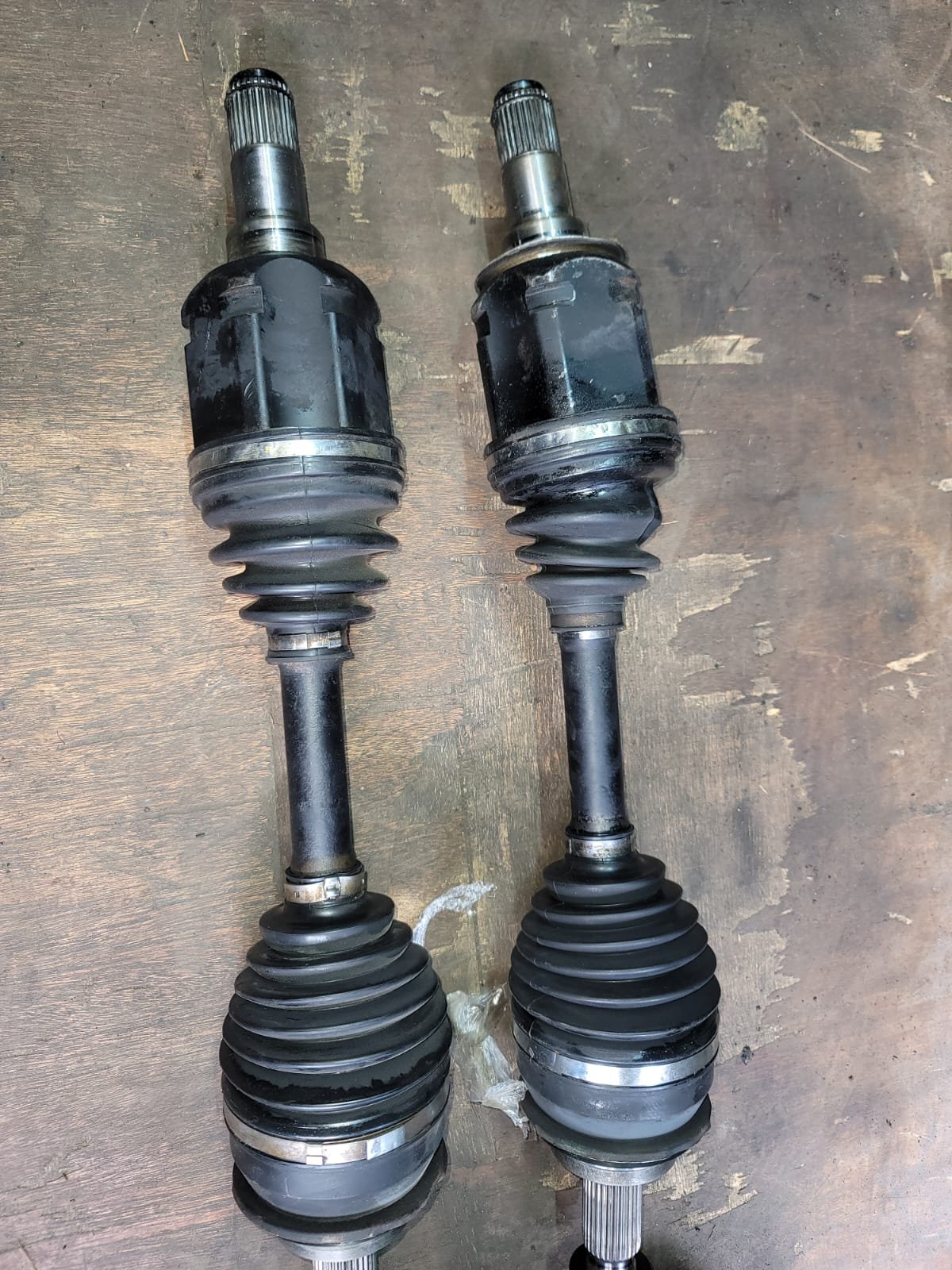
On an FWD car, the front CV axles must perform a demanding double duty: transferring rotational engine torque to the wheels while simultaneously flexing up and down over bumps and pivoting left and right for steering.
- The Wear Point: Outer rubber CV boots flex constantly during cornering. Exposure to fine road dust, gravel debris, and ozone heat cycles causes rubber boots to tear. Once a boot splits, grease flings out and grit enters, grinding down the internal ball bearings and tripod joints.
- Replacement Spares Needed: Inner and outer rubber CV boot repair kits, high-temp molybdenum grease, or complete heavy-duty CV axle shaft assemblies.
To browse chassis-matched front drive axles and CV boot repair kits, explore the Taleon Spares Kenya Parts Collection.
Component 2: Transaxle Fluid, Strainers, and Pan Gaskets
FWD transaxles contain both the main gearbox (automatic, manual, or CVT) and the front differential in one shared casing.
- The Wear Point: In heavy Nairobi traffic, fluid inside the transaxle operates under high thermal stress. Because the front differential shares fluid with the main gearset, mechanical wear particles circulate through one shared fluid reservoir.
- Replacement Spares Needed: Manufacturer-specified transmission fluid (e.g., Toyota Genuine ATF WS / CVT FE, Honda HCF-2), internal filter strainers, and oil pan gaskets.
Component 3: Heavy-Duty Front Suspension (Control Arms & Struts)
Because the front axle carries over 60% of the vehicle’s total weight in FWD designs, front suspension components wear out significantly faster than rear items.
- The Wear Point: Lower control arm rubber bushings, ball joints, and upper MacPherson strut mounts absorb heavy kinetic energy when striking high-rumble speed bumps or deep asphalt potholes.
- Replacement Spares Needed: Front shock absorbers (KYB Excel-G or Tokico), lower control arm assemblies (555 Sankei), ball joints, and sway bar link kits.
Component 4: Front Braking Components
FWD vehicles rely on their front brakes for approximately 75% to 80% of total stopping force due to forward weight transfer during deceleration.
- The Wear Point: Front brake pads and ventilated rotors experience intense thermal wear, requiring replacement roughly twice as often as rear brake pads or rear drum shoes.
- Replacement Spares Needed: High-friction ceramic or semi-metallic front brake pads (Akebono, Brembo, or Textar) and ventilated brake rotors.
Stay updated on suspension maintenance guides, drivetrain troubleshooting, and technical service checklists by visiting the Taleon Spares Kenya Blog & News.
3. AWD Replacement Parts Inventory Breakdown
While All-Wheel Drive provides superior traction on slick tarmac and unpaved upcountry tracks, its extra hardware introduces an extensive list of specialized replacement parts that FWD owners never have to buy.
                      PRIMARY AWD REPLACEMENT PARTS INVENTORY
                                         |
    +-----------------+------------------+------------------+-----------------+
    |                 |                  |                  |                 |
    v                 v                  v                  v                 v
[1. Transfer Case /   [2. Center Propeller[3. Rear Diff Unit [4. Complete Set  [5. Four Matching
  PTU & Seals]         Shaft & U-Joints]  & Pinion Seals]   of 4 CV Axles]     Tires (Strict)]
Component 1: Transfer Case / Power Transfer Unit (PTU)
The transfer case is bolted to the main transmission casing, splitting rotational power and directing a portion toward the rear driveshaft.
- The Wear Point: Transfer cases carry small fluid capacities (often less than 1 liter of heavy gear oil). High-speed highway driving combined with high ambient heat breaks down this small fluid volume quickly. Neglecting transfer case oil changes leads to gear whining, seal failure, and internal bearing seizure.
- Replacement Spares Needed: 75W-90 / 80W-90 Synthetic Gear Oil, transfer case input/output oil seals, and drain plug washers.
Component 2: Center Propeller Shaft (Driveshaft), Universal Joints, and Carrier Bearings
To transfer power from the front transfer case to the rear differential, AWD vehicles feature a long, multi-piece steel or aluminum propeller shaft spinning beneath the floor pan.
- The Wear Point: Propeller shafts feature internal Universal Joints (U-joints) and a central rubber-mounted Center Carrier Bearing that supports the weight of the shaft. Constant chassis flex and road vibration tear the rubber carrier mounting, causing intense floorpan vibrations under acceleration.
- Replacement Spares Needed: Center support carrier bearings, heavy-duty U-joints, and driveshaft flex discs (guibos).
Read more about our commitment to bringing verified, authentic components to vehicle owners across Kenya by reading Our Story at Taleon Spares Kenya.
Component 3: Rear Differential Unit and Axle Seals
The rear differential receives power from the propeller shaft and splits torque between the rear left and right wheels, allowing them to rotate at different speeds during cornering.
- The Wear Point: Rear differential pinion seals and side axle seals weep oil over time. Operating an AWD differential on low fluid levels leads to ring-and-pinion gear wear, producing a high-pitched howling noise at highway speeds.
- Replacement Spares Needed: Synthetic gear oil, differential pinion seals, side drive axle seals, and magnetic drain plugs.
Component 4: Four CV Axle Shaft Assemblies (Front & Rear)
Unlike FWD vehicles which feature only two front drive axles, AWD vehicles feature four complete CV axle shafts (two front, two rear).
- The Wear Point: You double your risk of torn CV boots and worn axle joints. AWD vehicles feature a total of 8 rubber CV boots that require regular inspection for cracks and grease leaks.
- Replacement Spares Needed: Front and rear left/right CV axle assemblies, boots, and retainers.
Component 5: Matched Set of Four Tires (Strict AWD Requirement)
One of the most surprising ongoing operational costs of owning an AWD vehicle is strict tire management.
- The Wear Point: Because AWD center differentials and viscous couplings lock power across all four wheels based on rotational speed balance, all four tires must have virtually identical rolling circumferences (tread depth differences under 2mm).
- The Risk: If an AWD owner replaces only one damaged tire with a new one while leaving three half-worn tires on the car, the slight difference in wheel rotation speed tricks the center differential into slipping constantly, burning out center clutch packs and destroying the transfer case within thousands of kilometers. FWD vehicles, by contrast, easily tolerate replacing tires in pairs (front or rear).
4. Maintenance & Replacement Cost Comparison: FWD vs. AWD
To summarize how FWD and AWD compare across routine maintenance and major component replacements under local driving conditions:
+-------------------+-----------------------------------+-----------------------------------+
| Service / Part    | Front-Wheel Drive (FWD)           | All-Wheel Drive (AWD)             |
+-------------------+-----------------------------------+-----------------------------------+
| Drive Axles       | 2 Front CV Axles                  | 4 CV Axles (Front & Rear)         |
| Driveline Fluids  | 1 Fluid Change (Transaxle only)   | 3 Fluid Changes (Transmission,    |
|                   |                                   | Transfer Case, Rear Differential) |
| Driveshaft / Prop | None (No rear driveshaft)         | Propeller shaft, U-joints, &      |
| Components        |                                   | center carrier bearing required   |
| Tire Replacement  | Can replace tires in pairs (2)    | Must replace all 4 tires together |
|                   |                                   | to protect AWD transfer case      |
| Suspension Wear   | Accelerated front wear; rear      | Balanced wear across all four     |
|                   | suspension lasts much longer      | corners; multi-link rear maintenance|
| Mechanical Risk   | Simpler layout; fewer failure     | Higher complexity; leaking seals  |
| Profile           | points under harsh road stress    | or binding diffs risk drivetrain  |
+-------------------+-----------------------------------+-----------------------------------+
5. Diagnostic Guide: Spotting Drivetrain Failure Symptoms
Recognizing the early warning signals of drivetrain wear allows you to replace seals, boots, or bearings before a complete breakdown occurs.
                      DRIVETRAIN FAILURE DIAGNOSIS FLOW

  [Diagnostic Symptom Experienced While Driving]
                |
    +-----------+-----------+-----------------------+-----------------------+
    |                       |                       |                       |
    v                       v                       v                       v
[Clicking Noise on     [High-Pitched Howl      [Floorpan Vibration     [Grease Splattered
 Sharp Turns]          at Highway Speeds]      Under Acceleration]     Inside Wheel Arch]
 Worn outer CV joint   Low fluid or worn ring  Failing propeller shaft  Torn rubber CV boot
 (Front on FWD/AWD).   & pinion in rear diff.  center carrier bearing.  letting joint run dry.
Symptom 1: Loud Clicking or Popping Noise During Sharp Turns
- Cause: Worn outer CV joints. When ball bearings inside the outer CV joint housing become pitted or starved of grease due to a torn boot, they pop loudly when turning into tight parking spots or roundabouts.
- Drivetrain Context: Extremely common on FWD front axles due to steep steering angles; also affects AWD front and rear outer joints.
Symptom 2: High-Pitched Whining or Howling at Highway Speeds
- Cause: Worn differential bearings or ring-and-pinion gears running on low oil. If the howling noise changes pitch when you step on or off the accelerator, the rear differential or transfer case requires servicing.
- Drivetrain Context: Exclusively affects AWD transfer cases and rear differential units.
Symptom 3: Thumping or Shuddering Under Hard Acceleration
- Cause: Worn inner CV tripod joints or a worn propeller shaft center support bearing. When accelerating uphill or carrying heavy passenger loads, mechanical play causes the driveshaft to wobble out of balance.
Symptom 4: Grease Splattered Across Inner Wheel Wells or Brake Components
- Cause: Split rubber CV boot. Centrifugal force flings black molybdenum grease out of the split boot onto surrounding suspension arms and inner brake discs.
- Action: Replace the boot and repack the joint immediately before dirt destroys the internal steel bearings.
6. Sourcing Genuine Drivetrain Parts: Avoiding Counterfeits in Kenya
Because CV axles, driveshaft bearings, and differential seals operate under immense torque loads, sourcing high-grade, authenticated parts is mandatory. The local aftermarket contains low-quality counterfeit axles made of unrefined steel that snap under acceleration.
                  COUNTERFEIT SOURCING SAFEGUARDS

  [1. Inspect Packaging]     ==> Check for crisp typography, holograms, & clean box seals.
           |
  [2. Verify Steel Machining]==> Genuine OES axles (HDK, NKN) feature clean splines & laser marks.
           |
  [3. Demand ETR Invoices]   ==> Insist on itemized receipts specifying exact brand names.
           |
  [4. Buy Direct]           ==> Source through verified digital stockists like Taleon Spares.
Trusted OES & OEM Drivetrain Brands:
- CV Axles & Boot Kits: HDK (Japan), NKN (Japan), NTN, GSP.
- Bearings & Seals: NSK, Koyo, NTN, NOK Oil Seals.
- Driveline Lubricants: Total, Shell Spirax, Eneos, Liqui Moly.
- Suspension & Steering: 555 Sankei, KYB, CTR.
Summary Drivetrain Maintenance Reference Table
| Drivetrain Component | Vehicle Type | Recommended Inspection | Replacement Interval (Kenyan Roads) | Preferred OES Brand |
|---|---|---|---|---|
| Front CV Boot Kits | FWD & AWD | Every 10,000 km | Inspect every oil change; replace if split | HDK, NKN, NOK |
| Complete CV Axle Assembly | FWD & AWD | Every 20,000 km | 80,000 – 100,000+ km | HDK, NKN, GSP |
| Transfer Case Fluid | AWD Only | Every 20,000 km | 30,000 – 40,000 km | Total, Eneos, Mobil 1 |
| Rear Differential Fluid | AWD Only | Every 20,000 km | 30,000 – 40,000 km | Total, Shell, Liqui Moly |
| Center Carrier Bearing | AWD Only | Every 20,000 km | 60,000 – 80,000 km | NSK, Koyo, Febi Bilstein |
Final Thoughts: Choose the Right Layout and Maintain It Smartly
Both Front-Wheel Drive and All-Wheel Drive offer distinct advantages for Kenyan motorists. FWD provides unmatched fuel efficiency, lower purchase costs, and a simple, budget-friendly replacement parts footprint—making it ideal for urban commuting and family travel on paved roads. AWD provides formidable all-weather traction, stability on slick tarmac, and off-road confidence across upcountry feeder routes, but it demands disciplined driveline fluid maintenance, strict tire matching, and budget allowance for additional moving parts.
Whichever drivetrain layout you own, keeping it reliable requires disciplined preventative care and access to verified replacement parts. By inspecting CV boots regularly, servicing transfer cases and differentials on schedule, and sourcing authenticated OEM and tier-one OES components, you ensure uncompromised safety, smooth power delivery, and long-term driving performance.
Keep your drivetrain running smoothly. Browse authenticated drive axles, CV boot kits, differential seals, transfer case fluids, and suspension parts on the Taleon Spares Kenya Shop today and enjoy fast, reliable delivery straight to your doorstep or garage anywhere across Kenya!
Add a review
Your email address will not be published. Required fields are marked *