
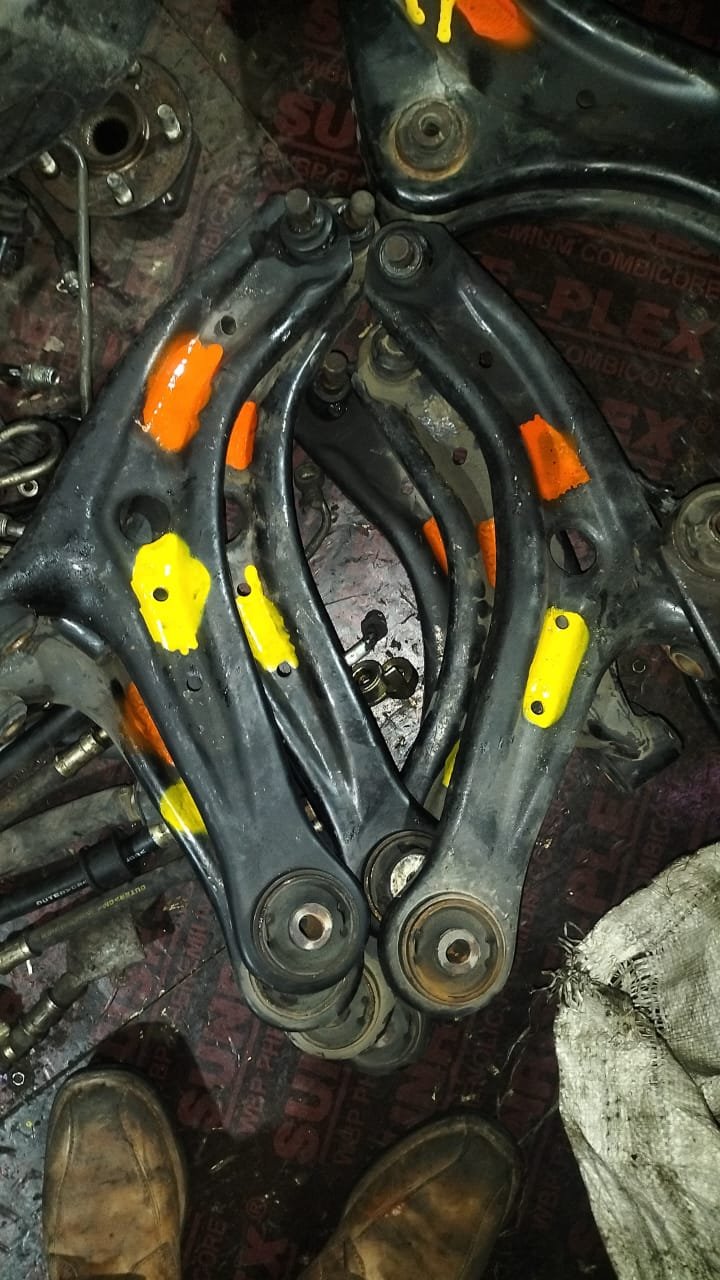
The Ultimate Guide to Lower Control Arms: When to Replace vs. Repair
If you’ve ever felt your steering wheel “pull” to one side, or heard a mysterious clunk when you hit a pothole in Nairobi, you’ve likely encountered a problem with your Lower Control Arms.
For many Kenyan drivers, the suspension system is a bit of a mystery. We know about shocks and tires, but the control arms are the “skeleton” that holds everything together. At Taleon Spares Kenya, we get asked every day: “Do I need to buy the whole arm, or can I just change the rubber bushes?”
In this comprehensive guide, we break down everything you need to know about lower control arms, the dangers of “pressing” new bushes, and why Ex-Japan complete arms are often the smartest investment for your car’s longevity.
1. What Exactly is a Lower Control Arm?
Think of the control arm as the “hinge” that connects your car’s wheels to its frame.
- The Job: It allows the wheels to move up and down (when you hit a bump) while preventing them from moving forward or backward.
- The Components: A standard control arm has three critical points:
- The Inner Bushings: Rubber mounts that attach to the car’s chassis.
- The Ball Joint: A pivot point that attaches to the wheel hub (allowing the wheel to turn).
- The Metal Body: The solid “A-frame” or “L-frame” that holds it all together.
When any of these three parts fail, your steering becomes “loose,” your tires wear out prematurely, and your car becomes dangerous to drive at high speeds on the highway.
2. Signs Your Control Arms are Failing
How do you know it’s time to visit the Taleon Spares shop? Watch out for these four red flags:
A. The “Clunk” on Take-off or Braking
When you shift from ‘Park’ to ‘Drive’ and press the gas, do you hear a single thud? Or when you brake suddenly, does it feel like the wheel “shifts” forward? This is usually because the control arm bushings are torn, allowing the metal arm to hit the frame.
B. Steering Wheel Vibration
If your steering wheel shakes at 80km/h (but your wheels are balanced), your control arm bushings might be so worn that they are no longer absorbing road vibrations.
C. Wandering Steering
Does your car feel “darty”? If you’re driving straight but the car keeps pulling left or right—requiring constant correction—your control arms are likely out of alignment due to wear.
D. Uneven Tire Wear
Check the inner edge of your front tires. If the inside is wearing down faster than the outside, your control arm is likely “sagging,” which throws off your wheel’s camber.
3. The Big Debate: Replace the Bushings or the Whole Arm?
This is the most common question at our Kirinyaga Road shop. In Kenya, many roadside “fundis” will suggest just buying new rubber bushes and “pressing” them into your old metal arms using a hydraulic press.
Here is why Taleon Spares usually recommends replacing the COMPLETE arm:
| Feature | Replacing Only Bushings | Replacing Complete Arm (Ex-Japan/New) |
| Cost | Cheaper upfront. | Higher initial cost. |
| Labor | High (requires pressing/fitting). | Low (simple bolt-on). |
| Safety | Ball joint remains old/used. | New/Healthy Ball Joint included. |
| Longevity | 3–6 months on Kenyan roads. | 2+ years of reliability. |
| Integrity | Pressing can weaken the metal eyelet. | Factory-sealed integrity. |
The Risk of the Ball Joint: Even if you replace the rubber bushes, your Ball Joint (which is permanently attached to the arm in many models like the Mazda Demio or Toyota Vitz) might be ready to fail. If a ball joint snaps while you are driving, the wheel will literally fold under the car.
4. Why Ex-Japan Control Arms are a “Sweet Spot” for Value
At Taleon Spares Kenya, we specialize in Ex-Japan Lower Control Arms. These are original equipment (OEM) parts salvaged from vehicles in Japan.
- Better Metal: Original Toyota or Mazda metal is much stronger than cheap “aftermarket” arms made of thin steel.
- Factory-Pressed Bushes: The rubber in an Ex-Japan arm was installed by a robot in a factory, not by a hand-press in a local garage. This means it will last much longer under the stress of Nairobi potholes.
- Cost-Effective: You get the quality of a 40,000 KES “New Original” arm for a fraction of the price.
5. Specific Advice for Popular Kenyan Models
Toyota Allion / Premio / Fielder (ZRT260/ZRE142)
These cars are the kings of the road, but they are heavy. The rear bushing on the front control arm is a famous “weak point.” If you feel a “jerk” when you brake, it’s time to check these.
Mazda Demio (DE/DJ)
The Demio has a very lightweight suspension. Using heavy, poor-quality aftermarket arms can make the ride feel harsh. We recommend our Ex-Japan Mazda Arms to keep that “zoom-zoom” handling smooth.
Nissan Note (E11/E12)
Nissan suspension components are sensitive. If you replace the arm, always ensure you check the Stabilizer Links at the same time, as they usually wear out together.
6. Maintenance Tip: The “Post-Replacement” Alignment
Never—and we mean never—replace a control arm without going for 3D Wheel Alignment immediately after.
Because the control arm sets the position of the wheel, a new arm will slightly change your “Toe” and “Camber” settings. If you skip alignment, you will ruin a brand-new set of tires in less than a month.
Conclusion: Don’t Compromise on Steering
Your control arms are what keep you connected to the road. If you suspect yours are failing, don’t wait for a “wheel-off” accident.
Visit Taleon Spares Kenya today. We have a massive stock of Lower Control Arms for all Japanese models, including:
- Toyota (Vitz, Passo, IST, Wish, Noah)
- Nissan (Tiida, Sylphy, Serena, Dualis)
- Honda (Fit, Stream, Airwave)
Add a review
Your email address will not be published. Required fields are marked *